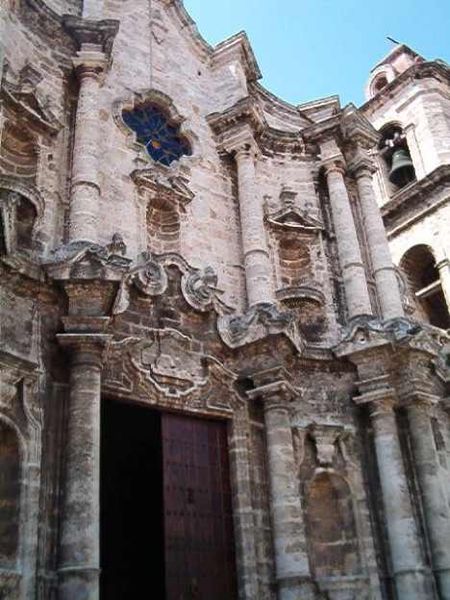
Cuba’s prevailing religion is Roman Catholicism, although in some instances it is profoundly modified and influenced through syncretism. A common syncretic religion is Santería, which combined the Yoruban religion of the African slaves with Catholicism and some Native American strands; it shows similarities to Brazilian Umbanda and has been receiving a degree of official support. The Roman Catholic Church estimates that 60 percent of the population is Catholic, but only 5% of that 60% attends mass regularly, while independent sources estimate that as few 1.5% of the population does so.
Membership in Protestant churches is estimated to be 5 percent and includes Baptists, Pentecostals, Seventh-day Adventists, Presbyterians, Anglicans, Episcopalians, Methodists, Religious Society of Friends (Quakers), and Lutherans. Other groups include the Greek Orthodox Church, the Russian Orthodox Church, Jehovah’s Witnesses, Muslims, Buddhists, Jews, Baha’is, and The Church of Jesus Christ of Latter-day Saints (Mormons).
Cuba is home to a variety of syncretic religions of largely African cultural origin. According to a US State Department report, some sources estimate that as much as 80 percent of the population consults with practitioners of religions with West African roots, such as Santeria or Yoruba. Santería developed out of the traditions of the Yoruba, one of the African peoples who were imported to Cuba during the 16th through 19th centuries to work on the sugar plantations. Santería blends elements of Christianity and West African beliefs and as such made it possible for the slaves to retain their traditional beliefs while appearing to practice Catholicism. La Virgen de la Caridad del Cobre (Our Lady Of Charity) is the Catholic patroness of Cuba, and is greatly revered by the Cuban people and seen as a symbol of Cuba. In Santería, she has been syncretized with the goddess Ochún. The important religious festival “La Virgen de la Caridad del Cobre” is celebrated by Cubans annually on 8 September. Other religions practised are Palo Monte, and Abakuá, which have large parts of their liturgy in African languages.
After the communist revolution of 1959, the government of Cuba restricted religious practice; this led to persecution of many Catholics at universities and in workplaces. As of 2013 the government recognizes the right of citizens to profess and practice any religious belief within the framework of respect for the law.
From 1957 to 1961 eighty percent of the professional Catholic priests and Protestant ministers left Cuba for the United States. Relationships between the new government and congregations became tense, and the new Cuban government was very limiting and suspicious of church operations, blaming them for collaboration with the CIA during the Bay of Pigs invasion of April 1961 and for stockpiling arms for a “counter-revolution”.
In accordance with the traditional anti-religious doctrine of Marxist-Leninist ideology, the state adopted a policy of promoting atheism. Religious beliefs were considered backward, reactionary, ignorant, and superstitious. The ‘Committees for Defense of the Revolution’ said: It is not good for your children to go to church.
Studies appeared that attempted to link Afro-Cuban religions with mental illness. The campaign for the eradication of racial discrimination in Cuba was (and still is) used as grounds to forbid the creation of Afro-Cuban institutions, because doing so was labelled as racially divisive.
Religious believers suffered from discrimination at schools and at work.
The decade following the 1960s was turbulent, and many believers chose to hide their faith in response to state persecution. Many parents did not wish to burden their children with the difficulties they would inherit if they were baptized Christians, and therefore did not raise them as such. The Archdiocese of Havana in 1971 reported only 7000 baptisms. In 1989 this figure had increased to 27,609 and in 1991 to 33,569.
In 1985 the Council of State in Havana published a best-selling book called Fidel y la Religion, which was the condensed transcription of 23 hours of interviews between Fidel Castro and a Brazilian liberation theology friar named Frei Betto, O.P. He claimed responsibility for excluding non-atheists from Communist Party membership on grounds that:
What we were demanding was complete adherence to Marxism-Leninism…It was assumed that anybody who joined the party would accept the party’s policy and doctrine in all aspects.
In the years following the collapse of the Soviet Union, the state adopted a more conciliatory position towards religion and lessened its promotion of atheism. In November 1991 the Communist Party began to allow believers into its ranks. In July 1992, the constitution was amended to remove the definition of Cuba as being a state based on Marxism-Leninism, and article 42 was added, which prohibited discrimination on the basis of religious belief. Small worship centres were legally permitted to exist again.
Nevertheless, by the early 1990s, after three decades of state atheism, Cuban society had become almost totally secularized. Weekly church-attendance on the island of 11 million was estimated[by whom?] at around 250,000 or about 2% of the population (with an even division between Catholics and Protestants). Cuba had fewer priests per inhabitant than any other Latin American country.
Since 1992, restrictions have been eased, and direct challenges by state institutions to the right to believe eased somewhat, though the Roman Catholic church still faces restrictions of written and electronic communication and can only accept donations from state-approved funding sources. The Roman Catholic Church is made up of the Cuban Catholic Bishops’ Conference (CCBC), led by Jaime Lucas Ortega y Alamino, Cardinal Archbishop of Havana. It has eleven dioceses, 56 orders of nuns and 24 orders of priests.
The Cuban Bishops’ conference has severely criticized the US embargo against Cuba and has claimed that the entire population has suffered from it. The United States Conference of Catholic Bishops has been influenced by this and has argued for the exclusion of food and medicine from the embargo.
In January 1998, Pope John Paul II paid a historic visit to the island, invited by the Cuban government and the Catholic Church in Cuba. He criticized the US embargo during his visit.
On October 20, 2008, the first Russian Orthodox Church in Cuba opened during an official ceremony attended by Raul Castro.