Taken from Kingdom of Cambodia: Law and Religion Framework Overview (2014) by Annette Knight (notes omitted)
I. SUMMARY
This overview summarizes the legal and political landscape regarding religious liberties and policies in the Kingdom of Cambodia (Cambodia), and provides a diagram of government organization. Relevant laws, policies, and persons of interest will be addressed.
II. RELIGIOUS CONTEXT ANALYSIS
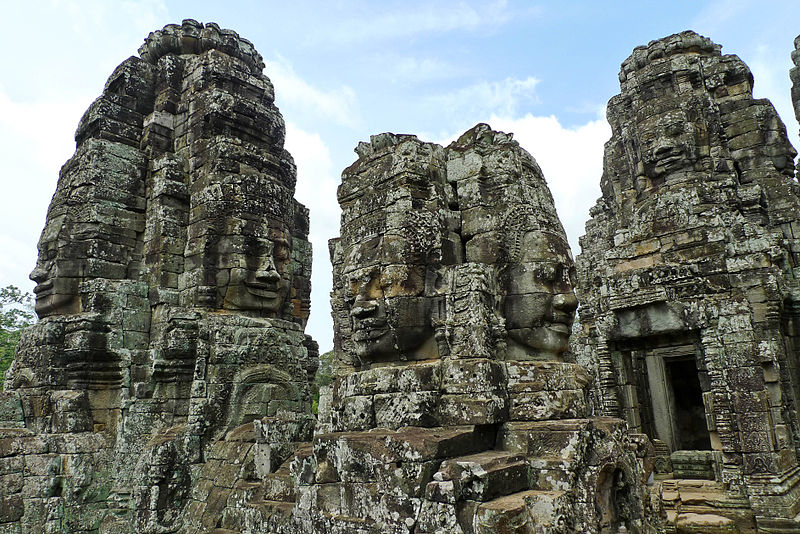
Most Cambodians consider themselves to be Khmers, who are descendants of the Angkor Empire that ruled much of Southeast Asia in the 10th to 13th centuries. The country became a Protectorate of France in 1863 and then became part of French Indochina in 1887. Cambodia gained independence from France in 1953. The country fell under communist Khmer Rouge control in 1975 and then Vietnamese control in 1979 when the People’s Republic of Kampuchea was established, which touched off almost 13 years of civil war. In 1991, the Paris Peace Accords mandated democratic elections and a ceasefire, but factional fighting continued until 1998. Over time, political stability took hold, and the 2007 local elections and the 2008 national elections were generally peaceful. The country is now a multiparty democracy under a constitutional monarchy.
The constitution and other laws and policies protect religious freedom. The government generally respects religious freedom, a practice that has not significantly changed in recent years. The State department reported few incidents of societal abuses or discrimination based on religious affiliation, belief, or practice.
According to the 2012 U.S. government estimate, the population of Cambodia is over fifteen million. The principal ethnic groups are Khmer (90%), Vietnamese (5%), Chinese (1%) and other (4%). Khmer is the official language. The vast majority of ethnic-Khmer Cambodians are Buddhist, and there is a close association between Buddhism, Khmer cultural traditions, and identity and daily life. According to the Ministry of Cults and Religion, the Mahayana school of Buddhism has approximately 19,550 followers and has 167 temples throughout the country.
An estimated 96 percent of the population is Theravada Buddhist. The Muslim faith makes up approximately 2.4 percent of the population. Members of the Muslim faith are predominantly ethnic Chams typically living in towns and rural fishing villages on the banks of the Tonle Sap Lake and the Mekong River, and Kampot Province. The four branches of Islam comprise the Malay-influenced Shafi branch practiced by 90 percent of Muslims; the Saudi-Kuwaiti-influenced Salafi (Wahhabi) branch; the indigenous Inman-San branch; and the Kadiani branch. Although surveys of Cham Muslims indicate that they perceived that institutional cultural barriers to full integration in society still exist, there are Cham Muslims, albeit few, holding prominent positions in business and the government. The remaining 1.6 percent of the population comprises Bahai, Jewish, ethnic Vietnamese Cao Dai, and members of various Christian denominations. Some Cambodians, particularly in rural or indigenous areas, are animists.
Buddhism is the official religion of the state. Buddhist holidays are promoted by the government. The following religious holidays are observed by the government as national holidays: Khmer New Year, Pchum Ben (Ancestors’ Day), Visakha Bochea (a day honoring the Buddha’s birth, enlightenment and death), Meak Bochea (a day honoring the Buddha’s post-enlightenment, when the Buddha preached the sermon on the terms of acquiring enlightenment and also predicted his own death). Cambodians also celebrate Chinese New Year, although it is not an official holiday. The government also provides Buddhist training and education to monks and others in pagodas, and modestly supports an institute that performs research and publishes materials on Khmer culture and Buddhist traditions.
In public schools, only Buddhist religious instruction is permitted by the government. Other forms of religious instruction are prohibited in public schools, but may be provided in private educational institutions.
The 1993 constitution provides for a wide range of internationally recognized human rights, including freedom of the press. While freedom of the press has improved markedly in Cambodia since the adoption of the constitution, limitations still exist on mass media. Much of the written press, while considered largely free, has ties to individual political parties or factions and does not seek to provide objective reporting or analysis. Broadcast media, in contrast to print, is more closely controlled. It tends to be politically affiliated with the Cambodian People’s Party (CPP), and access for opposition parties is extremely limited.
The Pew Research Religious Hostilities report indicates that Cambodia has a moderate score on the government restrictions on religion as of the end of 2012. For comparison, other countries in the moderate category include France, Mexico, Austria, Germany and the United States. The Pew Research Social Hostilities report indicates a low score for social hostilities. For comparison, other countries with a low score include Canada, Hong Kong, New Zealand and Taiwan (the United States is in the moderate category).
III. CONSTITUTIONAL PROVISIONS AND ORDINANCES ON RELIGION
The Constitution of the Kingdom of Cambodia was adopted by the Constitutional assembly on September 21, 1993. Buddhism was adopted as the State religion. The following are relevant Sections of the Constitution of the Kingdom of Cambodia (1993) which provide for religious freedom. ….
For more information see the links below.