Branden Kartchner
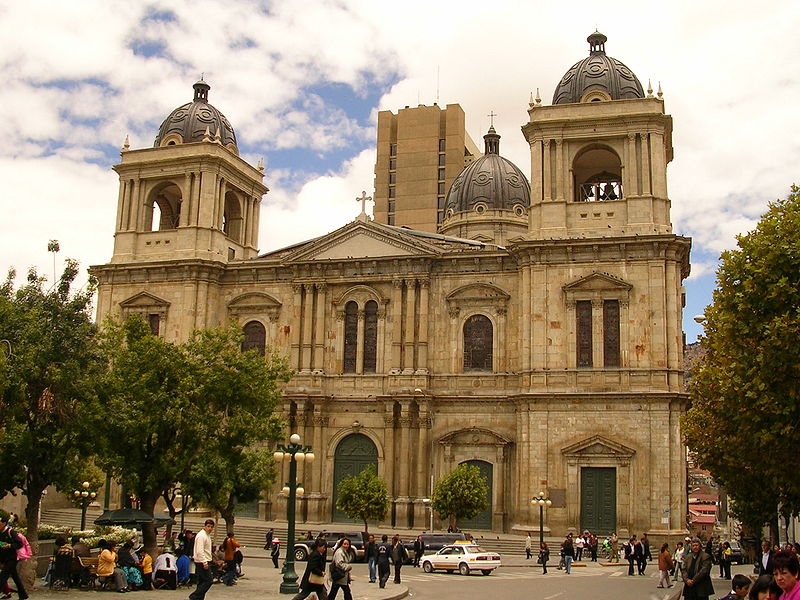
The formation of modern Bolivia began when the Spanish arrived and conquered indigenous groups around 1532. Shortly after their arrival, the Spanish introduced Catholicism to the indigenous population. Records of Catholic baptisms, marriages, and confirmations exist from as early as 1566. After the establishment of colonial Spanish rule, the Roman Catholic Church reached an agreement with the Spanish government that gave colonial authorities certain powers over church affairs in Bolivia. After centuries of Spanish colonialism, Bolivia gained independence in 1825. The Catholic Church remained the only religion in Bolivia until 1906 when the government advocated religious tolerance and “permitted the establishment of non-Roman Catholic churches.” In 1961, the Bolivian government suspended the long-standing practice of mediating the affairs of the Catholic Church. In time, Bolivia’s religious sphere became increasingly pluralistic as new religions were introduced into Bolivian society.
Since gaining autonomy in 1825, Bolivia has suffered a great amount of political instability as it has experienced nearly 200 coups and countercoups. After a number of harsh military regimes, democratic civilian rule was established in 1982.Along with political instability, Bolivia has faced extreme poverty, illegal drug production, and cultural divisions between the non-indigenous and indigenous population. In addition, Bolivia has experienced a number of human rights abuses. Many mysterious disappearances occurred during the military regimes. Even after democratic rule was established, many Bolivians did not feel that the new democratic system was providing effective political representation. In 2003, a number of demonstrators were murdered while protesting against the government, and seven high-ranking military officials and politicians have yet to be tried for their participation in the massacre. In addition, the government has brutally cracked down on civilians suspected of participation in illegal drug-production. Suspects have suffered prolonged detentions, alleged torture, and due process violations by both Bolivian and United States drug enforcement forces. It is clear that the respect for human rights has not always been practiced in Bolivia.
In 2009, Bolivia ratified a new democratic constitution, and no major human rights abuses have been reported since the adoption. However, cultural divisions have continued, and Bolivia has had diplomatic problems because of the political change. In September of 2008, the Bolivian Government expelled the United States Ambassador from Bolivia and the position currently remains vacant. However, the United States charge d’affaires and other embassy officials continue to reside in Bolivia. Recently, the two governments have attempted reconciliation by bilaterally signing an agreement to recognize critical differences and pursue improved relations. According to the 2001 census, Bolivia has a total population of about 10 million citizens. Of the population, 78 percent of citizens identified themselves as Roman Catholic, 16 percent as Protestant, 3 percent from other Christian religions, 2.5 percent practice no religion, and less than 0.2 percent claim affiliation with non-Christian faiths such as Islam, Judaism, Buddhism, Shinto, and the Baha’i Faith. In terms of religious participants who habitually practice their religion, 56.5 percent identify themselves as Catholic, 36.5 as Protestant, and 7 percent belong to other Christian Groups.
The traditional beliefs of the indigenous people are interesting aspects of religion in Bolivia. Currently, the indigenous population is estimated to be 55% of the total population. Certain indigenous groups have refused to accept the missionary efforts of Christian denominations who have attempted to replace traditional indigenous beliefs with modern doctrine, principles, and practices. Many characteristics of the pantheistic pre-Columbian era have survived including belief in supreme-beings such as the Sun God and Mother Earth.
Source: